Blog ·
Are E-numbers halal? What E471, E120 and E441 really mean
You turn the packet over and find E471, E120 and a list of chemical names. Are they halal? The short answer is that most are, and a few need a closer look.
Most E-numbers are halal. A small group can come from pork, insects or alcohol, and for those the label alone often can’t tell you. That is why a product without a halal logo can be so hard to judge in the supermarket aisle.
What is an E-number?
An E-number is a code for a food additive approved for use in Europe. The “E” stands for Europe, and the number tells you the family, more or less: E100s are colours, E200s preservatives, E300s antioxidants, E400s thickeners and emulsifiers, and E600s flavour enhancers. Many are perfectly ordinary: E300 is vitamin C and E330 is citric acid, found in lemons.
The additives Muslims should look at twice
- E120 (carmine or cochineal): a red colour made from insects. Sweets, yoghurts and drinks can contain it.
- E441 (gelatin): often made from pork or beef. Common in sweets, desserts and capsules.
- E471 and E472 (mono- and diglycerides): emulsifiers made from plant or animal fat. They are in bread, biscuits, margarine and ice cream.
- E422 (glycerol): halal from plants, haram from pork fat.
- E542 (bone phosphate): made from animal bones.
- E920 (L-cysteine): used in some breads, and it can have an animal origin.
Why “it depends” is the honest answer
The same code can be halal in one product and not in another, because the code names the substance, not its source. E471 made from sunflower oil and E471 made from pork fat look identical on a label. Scholars and halal authorities also don’t always agree on every additive. That is what doubtful, or mushbooh, means: not forbidden for certain, but better avoided until you know more.
Three simple habits
- Look for a recognized halal logo first. It answers the question for you.
- Check “suitable for vegetarians” or “plant-based”: it rules out animal sources, though not alcohol.
- When the product really matters, ask the manufacturer where the additive comes from.
Look up any E-number in seconds
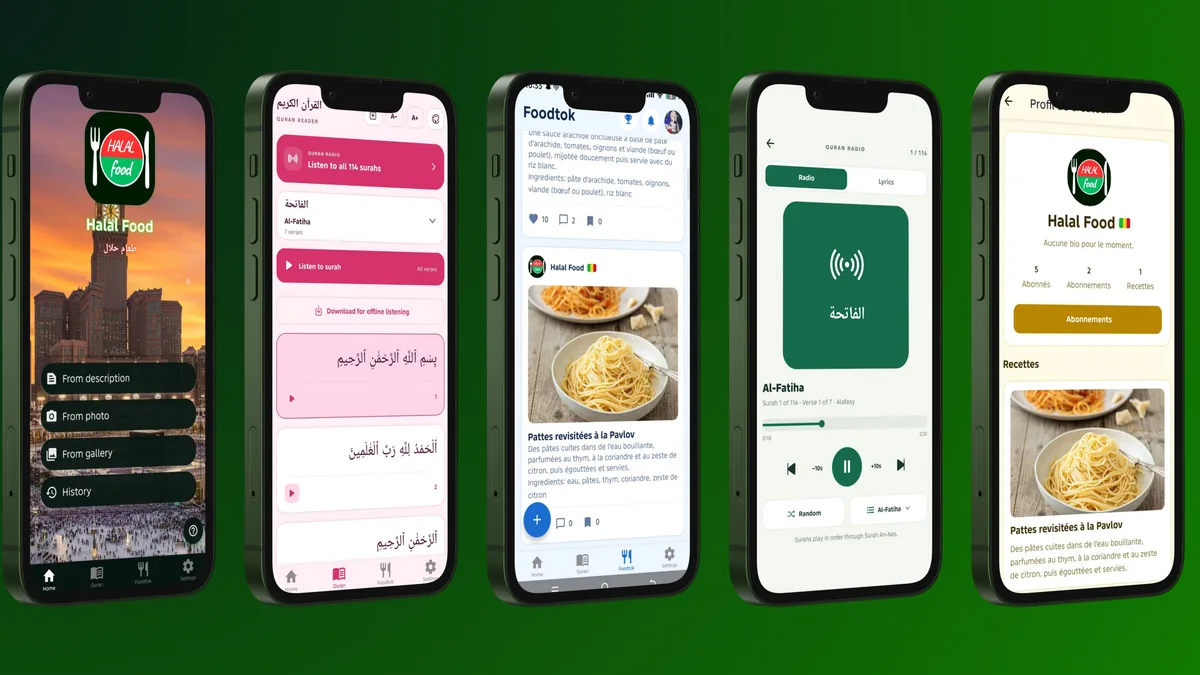
Remembering hundreds of codes isn’t realistic. Halal Food, a free app for iPhone, iPad and Android, puts them in your pocket: its E-codes list covers 337 additives. Search by code or by name, filter by Halal, Doubtful or Haram, and tap a line to read the reason in your language. When our sources disagree, the app shows the stricter reading, so you know when to be careful.
You can also skip the list altogether. Point your camera at a barcode or an ingredient list, or type a question like “Is sushi halal?”, and Halal Food tells you whether it is Halal, Haram or Doubtful, and explains why.
The same app also has a Quran reader, Quran Radio, a Qibla compass, a community for halal recipes and a game that teaches you to read labels. It is a helpful guide, not a religious ruling: for anything important, check with a scholar or a recognized halal authority.